
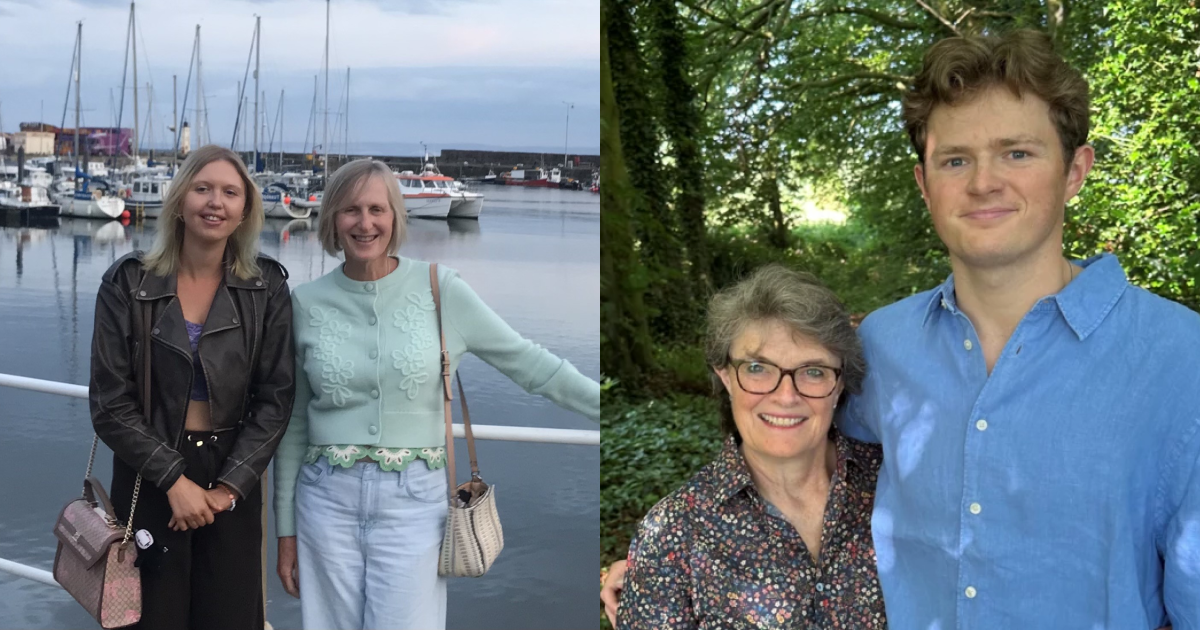
Sarah was four when she started passing blood in her urine. Nobody could have imagined that it was Alport syndrome.
Doctors first suspected another kidney condition. It was only four years later, when genetic testing became available, that Sarah and her family finally had an answer.
Sarah had autosomal recessive Alport syndrome caused by changes in the COL4A3 gene. Her parents were both undiagnosed when they got together. This gave them a 25% chance of having a child with Alport syndrome.
For years, Sarah managed her condition with regular monitoring and medication. But as she reached her 20’s, her kidney function began to decline rapidly. By March 2024, her kidneys were working at just 7%.
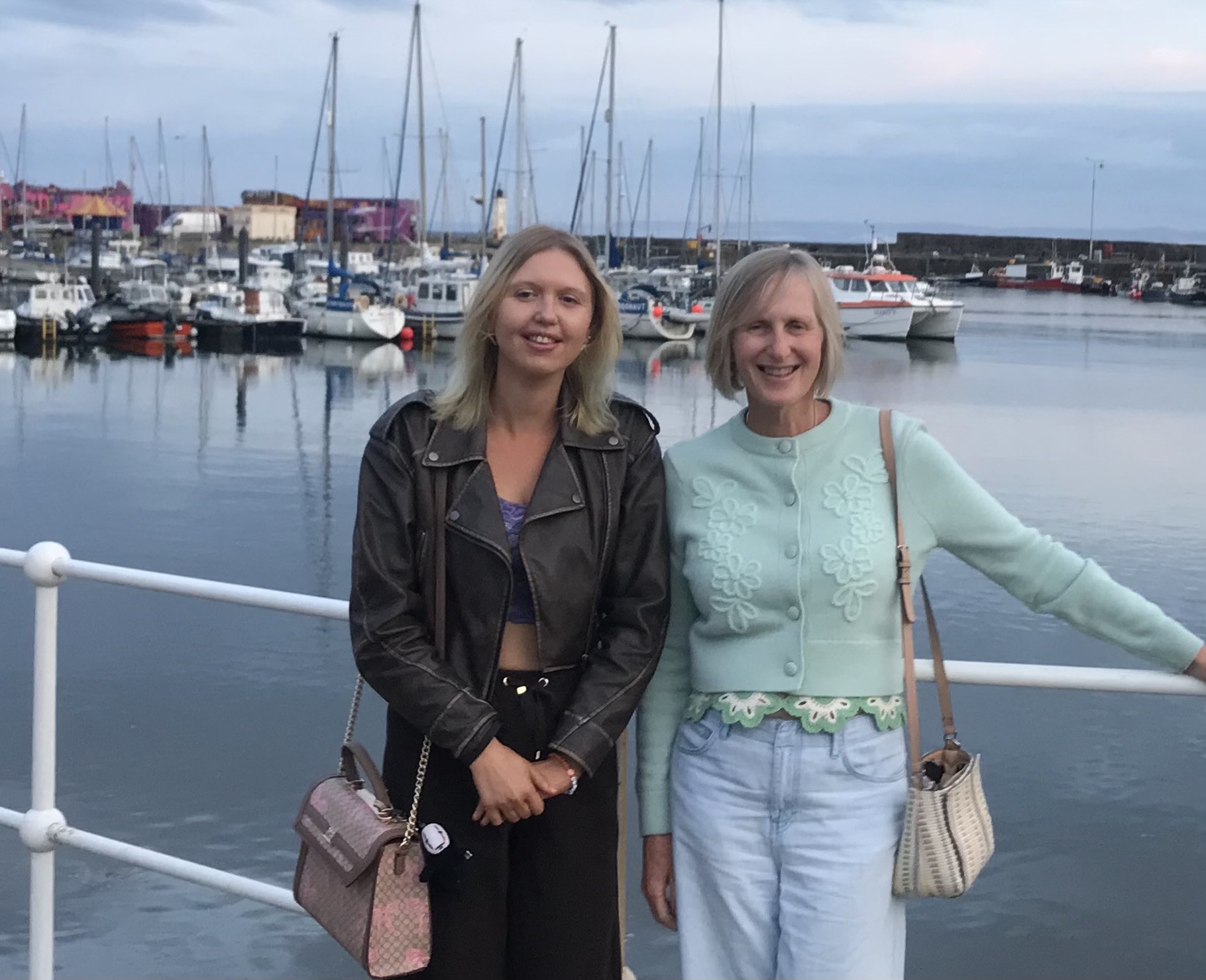
She started dialysis three times a week before moving to home dialysis later that year.
For Sarah, dialysis was exhausting. For her mum, Margo, life changed too.
As a retired nurse, Margo helped manage Sarah’s home dialysis. Holidays became almost impossible. Every trip had to fit around treatment schedules. Even arranging dialysis away from home was difficult because units were often full.
“It wasn’t just Sarah’s life that was on hold,” Margo says. “Mine was too.”
The first attempt to donate
Margo always hoped she could donate one of her kidneys to Sarah, given she had a milder version of Alport Syndrome.
Sarah had inherited two genetics variants: the COL4A3 genetic variant from her mother Margo, and another variant in COL4A4 from her father.
At 64, Margo was healthy, had normal blood pressure, and exercised regularly. Margo’s genetic variant caused her to have microscopic blood in her urine, but not protein, which is a sign that kidney disease is progressing.
After months of medical tests in 2024, Margo received devastating news: she was told she could not donate her kidney because she had the Alport gene.
For many families, that might have been the end of the story. For Margo’s family, it wasn’t.
The Facebook post
In December 2024, Sarah was scrolling through the posts in the Alport Warriors Facebook community.
She spotted a post from Susie Gear, CEO of Alport UK.
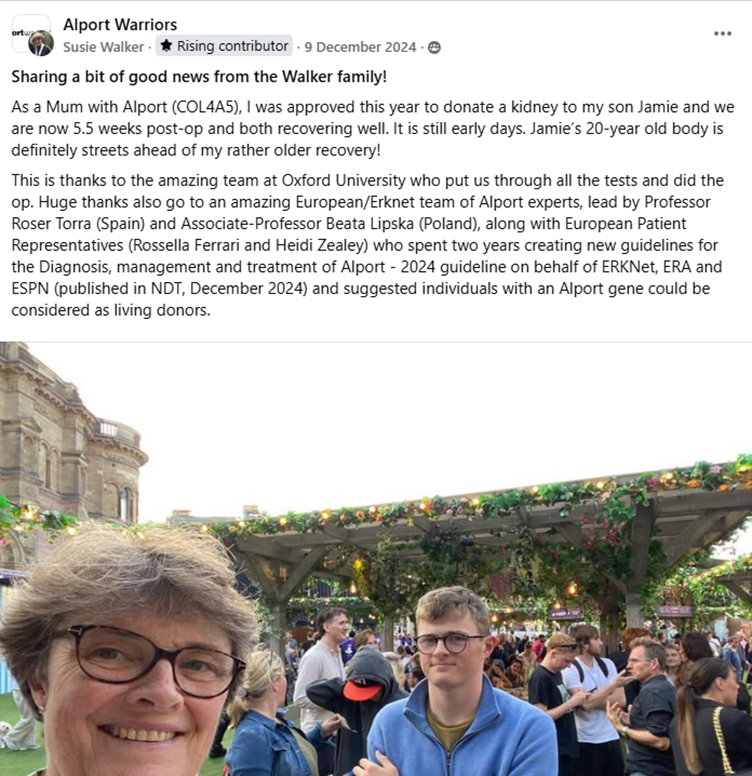
Susie had recently donated one of her kidneys to her son, Jamie, despite having an Alport-related genetic variant herself.
Even more importantly, Susie shared the newly published European clinical guidelines, which explained that people with mild forms of Alport syndrome can be considered on a case-by-case basis as living kidney donors following a detailed individual assessment and the rigorous live-donor testing.
Sarah immediately showed the post to her mum.
“I thought, ‘Hang on… this sounds just like me,’” Margo remembers.
Asking the doctors to look again
Armed with Susie’s post and the European guidelines, Margo contacted her transplant team at the Queen Elizabeth Hospital in Glasgow. Her case went back for review.
The team discussed the latest evidence and looked again at Margo’s individual situation. Because she had blood in her urine, they also performed a kidney biopsy to rule out any other cause. The results were reassuring.
Following careful assessment, the transplant team concluded that Margo could safely donate.
On 27 May 2025, at the age of 64, Margo donated one of her kidneys to Sarah.
Two mothers. Two children. One shared message.
Only a few months earlier, on 1 November 2024, Susie had donated a kidney to her own son, Jamie.
Although Susie and Margo have different genetic variants on different Alport genes, their situations were remarkably similar: both had lived healthy lives, both had excellent blood pressure and good kidney function. Most importantly, neither had consistent protein in their urine.
That careful clinical assessment made all the difference.
Today, both Jamie and Sarah have been given a second chance at life.
Why sharing our stories matters
For families living with Alport syndrome, information can be life-changing.
One Facebook post encouraged a family to ask another question.
One shared experience prompted doctors to review new evidence.
One conversation led to a life-changing transplant.
That is the power of community.
It is why Alport UK supports families, shares the latest research and guidelines, and creates spaces where people living with Alport syndrome can learn from one another.
Because sometimes, the information you need is waiting in someone else’s story.
Help create more stories like this
Every day, Alport UK connects families with trusted information, expert guidance and a supportive community.
Sometimes that means helping someone understand a diagnosis. Sometimes it means taking people out of isolation. And sometimes, as Margo and Sarah’s story shows, it can help change the course of a family’s life.
If this story has inspired you, please consider making a donation to Alport UK.
Your support helps us continue sharing life-changing information, supporting families, and making sure nobody has to face Alport syndrome alone.